McLouth: Pay cuts, liquidation?
Bitter news would hit McLouth Steel workers in February 1996, as management put forth a 23.5% pay cut. Unlike former refusals or strikes which took place in the 1980s, this pay cut request did pass – though barely. Meanwhile, Maurice Taylor put in his second official bid to purchase the company, which was also entertaining bids from Titan Steel and Ispat International). The offers did not materialize, and production at the Gibraltar and Trenton mills slowed to a crawl by March. Creditors then hopped in and stopped production altogether. Possibilities of a third offer were stalled by suspended talks in April. When talks resumed, a new potential buyer from Akron, Ohio entered the picture.
Big plans for the complex were announced, although they involved a possible liquidation of the company. Deemed “less than expected,” an auction for potential buyers was announced in June. Maurice Taylor, with his third attempt, was among the parties interested. Then an offer for $1.8 million in emergency financing was announced; a deal which the Downriver Community Conference bungled and eventually lost mid-month.
Could Riverview own a Bob-Lo boat?
Riverview residents were enjoying the possible honeymoon dream of purchasing a Bob-Lo boat in the spring of 1996, as the city was hoping to get in on the expected auction of the Columbia and Ste. Claire steamers, which at the time were property of the Federal government. Wyandotte’s Portofino Restaurant had purchased the smaller ferry Friendship in 1994 only added to the enthusiastic possibilities. The attempts would be for naught, as the steamers were instead sold to a group of private investors (heritage foundations) who would be charged with restoring the boats to their former, grand splendors.
“Erie County” proposal looks imminent
With little news in ensuing years since the Vision 21 Committee attempted to rebrand Downriver as “Metro Shores,” it was safe to say the Downriver name would stick. But this time, a larger name change – much larger – loomed as a possibility. Wayne County would be faced with the possibility of splitting into multiple, smaller counties; the most populous probable county, anchoring Downriver, would be named Erie.
Much initial press was made of this 1996 proposal, as many claimed Wayne County had gotten too big and apathetic, and could not provide the services needed by its increasing amount of residents. At first glance it appeared to be a throwaway issue, as prior attempts to secede in 1991 and 1992 failed easily. This attempt, however, had the backing of Leonard Mannausa, who was running for the 23rd District seat in the State House and was seeking 247,000 signatures to put the issue on the ballot. A proposed southern county (Newburg) would make the issue more interesting, as both the proposed Erie and Newburg Counties were including Taylor in their official proposals.
President Clinton visits on literacy campaign
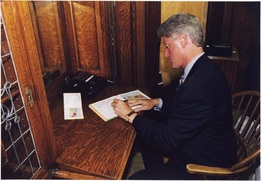
In August 1996, it was announced that President Bill Clinton would be visiting Wyandotte to give a speech on child literacy and education. This would be just the second time a sitting President would set foot in Wyandotte’s history. President Theodore Roosevelt had made a whistle-stop in 1902 enroute to an engagement in Detroit; he gave brief remarks from the rear platform car of the train.
President Clinton, in the midst of his re-election campaign, was opposed by Republican candidate Robert Dole. It was decided for Clinton to visit Wyandotte en route to Chicago for a convention stop.
Two sites were considered: Bacon Library or Roosevelt High School. After a second site survey, Bacon Library was decided as the venue.
Activity began at 6:00 AM the morning of the President’s arrival. Two hundred phone lines had been installed at the library complex for press coverage. A total of thirty-five Secret Service Agents – some of whom were stationed on the roof of Bishop Co-Op Apartments – told residents to close their drapes and “don’t look out.” Most of the Wyandotte Police were out among the crowd in addition to 67 officers from surrounding cities to assist. Not long after people were admitted to the site after 10:00 AM, the crowd would grow to an estimated 15,000 on an event that would be carried live by CNN. Emceed by then-State Representative Joseph Palamara, he first introduced Beth Murray, president of the Library Board. She proudly held an oversized library card and suggested the President could sign it.
Before the President was scheduled to speak at Bacon, he made a brief stop at the former train station at Oak and Seventh Streets; passing Pennsylvania Road en route he was seen waving to the crowd. While Clinton was readying himself inside one of Bacon’s reading rooms, students from McKinley Elementary School entertained the crowd by singing This Land Is Your Land, and It’s A Grand Old Flag.
After speeches by Congressman John Dingell and Senator Carl Levin, the President came out to great fanfare. His speech would last 22 minutes, and introduced his proposal for a $2.5 billion Literacy program, while also announcing the formation of Americorps, which would sponsor thousands of tutors with the ultimate goal of each child in the country being able to read proficiently by the third grade. After the speech, the President would meet for an hour with Civil Rights icon Rosa Parks, former Governor James Blanchard, Senators Donald Riegle, Carl and Sander Levin, and Representatives John Dingell and John Conyers.
 downriverhistory.blog