Downriver’s job placement program saved

Althought the stock market would begin to rebound in 1982, along with national economic outlooks, Michigan and Downriver were slower to react to the improvements. The Downriver Community Conference, meanwhile, was continuing to grow, and its job outreach service was seeing increased participation.
By the end of 1982, however, the DCC’s job service was fighting for its life.
Wayne County Executive William Lucas attempted to have the county take over the job training program. The attempt would fizzle when Governor James Blanchard, a DCC supporter, gave a March 1983 ruling allowing the DCC to continue overseeing this service, effectively ending Lucas’ attempts at a county takeover.
Allen Park to comply with sewer system
Two months later, a Federal Judge announced Allen Park would need to comply with a ruling to construct a sewer separation system which would aid in the cutback of water pollution. As recently as the early 1980s, for example, the Detroit River was often too polluted to even freeze over during the coldest winters. Allen Park had been looking into alternatives aside from a federal mandate for a few years, but had made no significant progress. Wastewater was still combining with storm water and discharging into Ecorse Creek. The new facility was designed by Wade-Trim Associates. Located near I-75 and Goddard Roads, the building would win awards for its modern design.
Another pioneering steel “first”
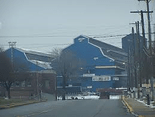
Forward thinkers from National Steel in Ecorse made an important July 1983 announcement possible.
The company would spend $200 million to construct an electrogalvanizing line (EGL) and a second continuous caster unit.
The EGL would make National Steel the first facility in the United States to produce continuous coated, rust-proof steel which would be mostly purchased by auto manufacturers.
Taylor School District navigates minefield
Heading back to school in the fall of 1983, students and their parents in the Taylor School District faced the possibility of a radical shakeup, the threats of which had not been heard of here before. The school district had major problems for over a decade and had fallen into receivership in the late 1970s. Strikes, picket lines and parent sit-ins were not uncommon. For a brief period, there had even been three superintendents simutaneously on the district’s payroll. The newest Superintendent – Jerry Montecillo – was charged with cleaning up the district under orders by State Superintendent Phillip Runkel.
Major cuts would take effect if a ballot referendum were not passed the following February. The ballot requested a 5.4 mill increase as well as approval of a $5.7 million deficit elimination bond. These proposed cuts were perhaps the most radical ever announced in the face of possible failure.
In the proposal – named the “Pack And Save Plan,” – half of the elementary schools (9 of 18) would close and students from the three high schools (Taylor Center, Kennedy and Truman) would all be brought together in two groups using one 5-hour shift at one high school. Bus service would also be eliminated. If the proposal was to fail, students would be directed to bring paper bags to their school the next day to pack up their books “for their new education.” In other words, failure of the bond would result in immediate consequences.
Fortunately, both the millage and bond passed easily in February 1984. A total of 17,690 residents came to vote, a number 2 1/2 times the amount of any prior failed millage.
 downriverhistory.blog