Eureka gets that “sinking” feeling
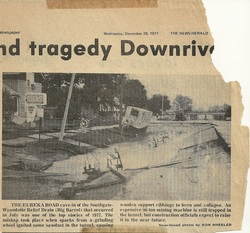
In July 1977, an accident underneath Eureka Road caused the westbound section between the railway trestles and 12th Street to collapse and sink, putting this busy stretch of road out of commission for nearly a year.
Work underneath the road had been ongoing as part of the long-running “Big Barrel” sewer project servicing the area. This area project was engineered by Hubbell, Roth & Clark, with United Construction and Mancini Construction the contractors.
Temporary tunnel bracing consisted of wood supports, whose sawdust caught fire that day. The fire spread to the wood support braces for the tunnel. Workers from Mancini Construction tried to put out the fire on their own before the Fire Department arrived. They sent down hoses with attachments that twisted, spraying water all throughout the affected area. Due to the fire and/or resulting loss in air pressure in the tunnel, cracks began to quickly form on the Eureka surface and – within minutes – the westbound portion sank along with the surrounding grassy area.
Fortunately, there were no injuries, as there had been enough time to warn motorists and pedestrians about the problem: Eureka had been closed for a couple hours prior to the sinking. Grosse Ile, Riverview and Trenton would lose water service as a result. The Detroit Water Board announced shortly after that water had been re-routed, but to expect lower water pressure than normal. The initial estimated time to repair Eureka Road was six to ten weeks.
Meijer Thrifty Acres opens in Taylor
Other areas of Eureka were looking better, though. Meijer Thrifty Acres opened their first store Downriver at Eureka & Pardee in Taylor in the summer of 1977.
The first “all in one” store (termed a hypermarket) in the area, it immediately began drawing people in and would foreshadow the current age, where most stores strive to be multi-purpose versus specialty. In a rarity for its time, the Taylor Meijer would be among the many 1970s-built Meijer stores to have a kids-based “Oasis” in the center of the store. This section was hugely popular, but was removed within eight years due to concerns for safety and responsibility.
The Neisner chain becomes history
Despite Downriver hosting three different dime store chains (which seems a small number compared to the numerous dollar stores seen today), Kresge, Neisner and Woolworth & Woolco were all holding their own until 1977, when Neisner would begin faltering.
The chain had decided to experiment with a larger, more traditional department store concept, titled “The Big ‘N'”, which sought to rival stores such as K-Mart. This launch failed, however; which jeopardized its core dime store business. Neisner did its best to ensure its customer base that the firm was healthy, and set out on a renovation that would totally re-dress its Lincoln Park and Wyandotte stores.
New colors (oranges and yellows) were introduced, new store fixtures were installed. To the delight of the dedicated customer base (and on the wishes of its Wyandotte store manager), the creaky, sloping wood floor was retained in its original state to add nostalgia value. It was a nod to history that was years ahead of its time.
This was not enough. Forced to file for bankruptcy, Neisner ended up bought out by the Ames Discount Store chain, and both Downriver stores wound up closed by the end of 1978.
 downriverhistory.blog