Riverview repurposing landfill?

Headlines went out the first week of January 1976 incorporated an un-heard of suggestion. The Riverview Landfill, in operation since 1968, was due to have its credible life expire within six to eight years and be closed off. The city of Riverview was in close contact with landfill engineer John Jenkins, who represented Jones & Henry Engineering, Ltd. of Toledo. The proposed idea was for a ski hill, something not seen of that stature before Downriver.
At the time, the hill was almost 150 feet high, but could be extended to 165 feet, or even 175 feet if an additional ten feet cap of earth was laid. This would allow for three potential ski lanes with a 12% sloping grade.
The project would start with beginners’ level slopes only, extending to intermediate and advanced skiing in later phases. The ski hill in its full form was expected to be open by the 1979 holiday season.
Additional announcements included making the entire area near the landfill user-friendly, as a 34 acre lake was proposed adjacent to the hill. The lake, which would be 30 feet deep in spots, would be fed by up to 175 million gallons of filtered water from the Frank & Poet Drain. The city could not rely on sanitary water (too expensive) and did not see themselves mining for mineral water underground. It was also mentioned that the lifespan of the hill could be extended indefinitely, as the Riverview School District proposed a land-swap deal which would give the Land Preserve additional acreage to the south and west to continue its operation into the 1990s.
Downriver Mutual Aid begins
The headlines of the March 4, 1976 News-Herald looked ominous: firefighters battling a real-life blaze in an old building with “arson” appearing in the first paragraph. But the fire was deliberately set by firefighters participating from five communities in addition to Grosse Ile. Downed as a result of this training exercise was the old Captain’s Quarters builiding at Grosse Ile Municipal Airport. This was one of the first major tests of the effectiveness of the future Downriver Mutual Aid system. A total of 110 personnel aided in the operation, which resulted in the abandoned building leveled in ninety minutes.
Grosse Ile Fire Chief Joe Miller said some initial problems did come into play, with the staged fire burning out of control in the middle of the building; but fires set on either end of the structure burned to satisfaction. “We learned a lot,” admitted the chief.
After years of haggling among local politicians, approval was finally granted for the Riverview Co-Operative Senior Citizen Apartment tower, to sit on Pennsylvania Road behind Korvette’s and next to St. Cyprian Church. This would be Downriver’s tallest structure to serve this purpose for many years.
Adult theater fare spares Wyandotte
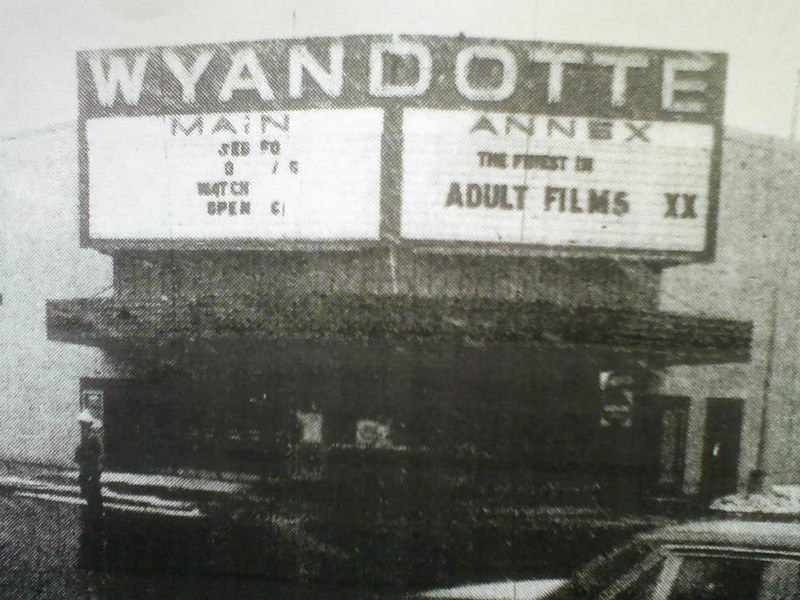
A concerning streak, meanwhile, finally came to a close at the Wyandotte Theater’s Annex section. Its new bill of Blazing Saddles and Chino were the first non X-rated movies to air from there in two months.
Its new bill of Blazing Saddles and Chino were the first non X-rated movies to air from there in two months.
Resulting police operations around adjacent businesses saw multiple cases of questionable publications being shelved at the Open Book store nearby, though they were within a clerk’s easy view and paper bag wrap covering front pages of the magazines.
The operator of the Wyandotte Theater said he was in no control of what was shown at the movie house; responsibility for that fell upon a theater operating company out of Southgate. The good news from all this was that no further scheduled X-rated features were planned to be shown at the Annex for the forseeable future.
School vandalism tied to Manson film
More troubling to the general public were the rapidly increasing counts of school vandalism Downriver, much of which was coincidentally tied to the 1976 showing of the television special “Helter Skelter,” which focused on the Charles Manson family murders of the 1970s. Sibley School in Trenton was vandalized in April to the tune of $6,000 – $7,000, mostly done over a four-hour period of window-breaking. Two area youths were quickly apprehended. “Helter Skelter” graffiti was found tagged in various locations at the school. The same month, Grosse Ile High School suffered $10,000 worth of damage to its structure, with its shop area the hardest hit. Classes there were canceled for two days as cleanup was initiated.
The following week (April 17), alert citizens stopped a possible fire from occurring at Lincoln Junior High School in Wyandotte. A small fire was quickly doused in a classroom. Three wine bottles had also been hurled through windows. Just two days later, a small fire also erupted at Schafer High School in Southgate. Damage there was not widespread, but the commons area near the gymnasium suffered heavy smoke damage, in addition to an “unknown substance” being found on the floor nearby. At the time, no one knew of any probable suspects. Reaction among various school principals was mixed as to the issue of the television movie being wholly responsible for the uptick in school vandalism.
Cracks showing in McLouth’s foundation
The first signs of stress at McLouth Steel – the newest of the three Downriver landmark steel mills – began surfacing in the 1970s, owing mainly to both the ongoing economic climate of the mid-1970s, as well as the increased proliferation of foreign imports of stainless steel product.
Federal assistance was being offered to those who had been laid off by the steel firm in the preceding few years, as per the Trade Act law of 1974. In just five short years, requests for stainless steel production had plunged from 180,066 tons in 1970, to 85,000 tons by 1975.
Although this latest action generally affected only the original Detroit plant (whose payroll shrunk from 1,150 in the early 1960s to 600), it was becoming clear that adjustments at the Trenton and Gibraltar mills might be forthcoming. It was hoped that the federal assistance could aid all three plants.
The debut of the Michigan Left
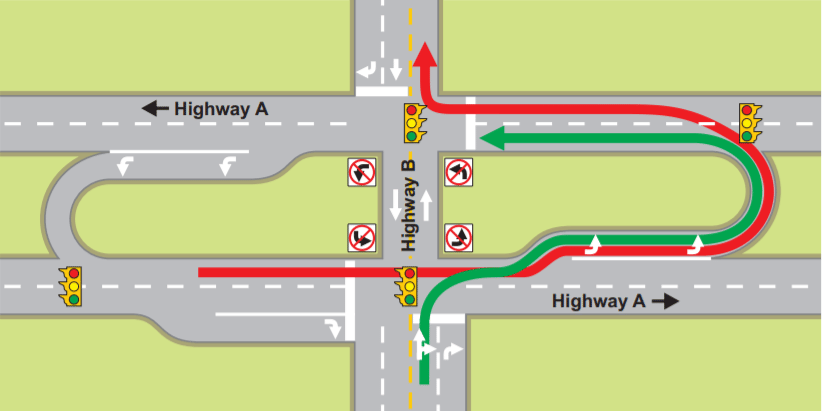
In May, construction barrels began popping up along Fort Street as the median would be torn up for much of the summer in the Southgate and Wyandotte portions. Workers were installing the first of the now-infamous “Michigan Left” turn-arounds, which back in 1976 were still simply called left-turn lanes. With this project came the questions as to why Fort Street wasn’t widened to four lanes across.
There were numerous areas of concern along the route, namely the Fort and Grove Street intersection on the Wyandotte side. Many cars had taken the curve in front of Danny’s Foods too quickly and either skidded off the road or into the ditch, although appropriate blame was also placed on the angle of the curve, not just speed limits.
Meanwhile, a new law had taken effect in late 1975 regarding right-hand turns, specifically on red lights. By the spring of 1976, Wyandotte Police Chief Marion Jezewski cited increasing concern about motorists disregarding oncoming traffic when making these turns, often requiring two lanes to do so. “Turning right on a red light,” the chief admitted, “is not always the best thing to do.”
Trenton & Woodhaven crossings troublesome
Motorist headaches of the present day are sometimes dominated by the difficulties in navigating around two railroad crossings in the Trenton and Woodhaven areas. These headaches, found on Allen Road, Fort Street and Van Horn Road, were causing delays and inconvenience before the 1970s and current wave of urban sprawl. Much of the arguments in favor of a railroad bypass (over or underground) centered around ambulances’ inability to get from the north end of the cities to the south. In May 1976, a tentative plan was announced which would allow Trenton firefighters a way to get around the daily logjams.
Trenton City Engineer Thomas Seymour introduced an indication system package which would enable the city’s two fire stations to connect directly with the rail crossings via relay. Its purpose would be to send alerts to the fire stations that a train was crossing (and possibly blocking) the affected areas. Fire dispatchers would then be able to send this message to the fire truck en route, where an alternate route through neighborhoods could be quickly taken to save time. The estimated cost to start up this system was pegged at $3,350, including an $8.95 monthly charge by Michigan Bell Telephone for relay service.
“The Bird” is the word in Southgate

The biggest sports name Downriver was the same name capturing attention all over the country: Mark Fidrych, the charismatic Detroit Tiger ace right-hander. He was profiled in the News-Herald at a meet-and-greet for children at a local pizzeria (the news article would not mention the name of it, but safe to say it was likely Little Ceasar’s Pizza Treat on Eureka Road, the former Shakey’s Pizza).
He was as down-to-earth locally as he was in the general public eye. He lived at the Fountain Park South apartments off Trenton and Leroy Streets during the season, where he would be selected as the starting pitcher for the American League All-Stars.
Asked how he liked living in Southgate, he said “it’s alright,” then simply shrugged his shoulders and smiled – definite hallmarks of “The Bird.”
Fire consumes Four Corners Plaza
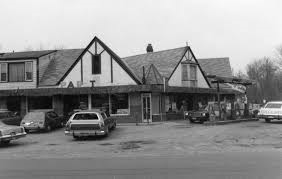
A three-alarm fire resulted in firefighters battling in vain to save the Four Corners Shopping Plaza at the corner of Meridian and Grosse Ile Parkway. After a four hour battle, the building, known for housing the Eat and Greet Nook, was considered a total loss.
The initial cause of the fire was suspected to be faulty wiring, although arson investigation units were still inspecting the property. The building, which had recently been offered on the market for $185,000, had many construction defects which helped spread the blaze quickly.
Constructed in the 1930s, it was thought the quality of lumber selected was dried out, there had been no recent fire inspections, numerous false (suspended) ceilings, air tunnels and no modern firewalls which could have contained the blaze.
The most frustrating issue from the firefighters’ perspective, however, was ongoing problems with water pressure, something the Fire Department would say was becoming an “as usual,” all-too common problem. The lines servicing that portion of Grosse Ile were laid in 1935, but a new water line for fire use would cost between $3 and $5 million dollars. In spite of the increasing population of Grosse Ile, that cost was still too high for the Township budget.
Four Corners would never be rebuilt. By the late 1970s, the environmental movement was beginning full-throttle on Grosse Ile. Gone would be the days of building for the sake of building. Although the Open Space Act was still years from passage, the downtick in construction and the new awareness of Grosse Ile’s natural areas would change the course of the township’s evolution.
The story of baby Joey Lewis
That Thanksgiving weekend, a horrifying discovery was made inside a Salvation Army dropbox located in front of the K-Mart on Eureka Road. A baby, less than two weeks old, was found inside the bin, abandoned in the freezing weather and covered only by a blanket wrapped in a paper bag. There was no danger of immediate suffocation, but hypothermia was a very real possibility.
The infant, 4 pounds 11 ounces at birth, was rushed to Wyandotte General Hospital for care. Hospital staff were pleased to report the baby, named Joey Lewis, was eating normally, and his weight was up to 5 pounds 4 ounces. The requests for adoption of Baby Joey were extremely high in number and delighted his caretakers at the hospital, which would ultimately send him to a foster home in the interim once his condition was stabilized. His parents were unknown and neither could be located, although a search for clues was ongoing.
 downriverhistory.blog