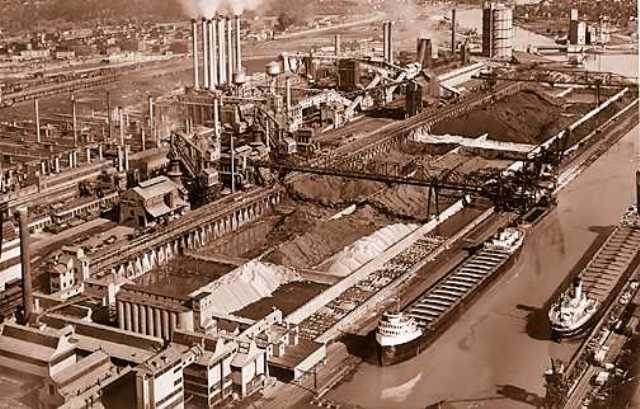
In July of 1920, following a three-year U.S. takeover of the railroad system, automotive pioneer Henry Ford purchased the local Detroit, Toledo and Ironton (DT&I) railroad spur, in the hopes of extending the line into his burgeoning Rouge factory complex. Most factory goods were being shipped to Rouge by rail, and Mr. Ford disliked the high fees the various railroad companies would charge for freight distribution.
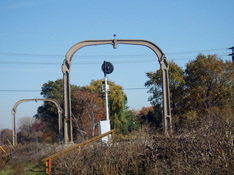
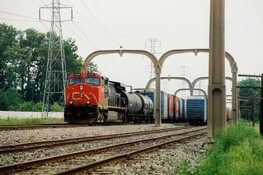
Bypassing the need to build power substations throughout the route to keep voltage steady, he erected the canternary arches which are prevalent Downriver today. The arches were completed from the Rouge complex to the village of Carleton. Foundations were built to continue the arches further to the rail junction at Diann, Michigan, but they were never completed.
The experiment — which involved a high voltage line strung above the arches, through a substation-like structure on top of each engine to step down the voltage, then convert it to DC current which actually ran the engine — was not a success. The first engines began running the line in 1927 but were pulled out of service in 1930, one year after Mr. Ford sold his interest to the Pennroad Corporation. In a cruel irony of sorts, Pennroad’s analysis determined operating costs could be reduced — by converting the line back to steam power.
The arches have lasted and have become Downriver landmarks due to their impervious construction: a total of 190 cubic yards of concrete were used just to create the bases for each arch. Demolition crews soon gave up the insurmountable task of removing them, so they stand as reminders today of both an early industry, and proof that even the most noted inventors’ ideas don’t always meet with instant success.
 downriverhistory.blog