Downriver residents may not know the grand scale of the industry which used to dominate the skyline and waterfront. In the days before conservation and environmentally conscious efforts became mainstream, our area was defined by many businesses which helped provide incomes to new residents who had relocated. The Ford Motor Company’s Rouge River plant was the trendsetter in the early part of the 1920s, with many of the new industrial firms replacing the farmland and marshes which Downriver housed for over 100 years. This is a but a sampling of the businesses which dotted (or continue to dot) the economic landscape.
All-Metal Products Company
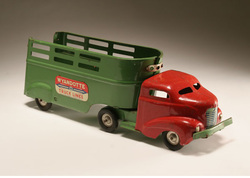
All Metal Products Company, popularly known as Wyandotte Toys, was founded in 1920. They produced inexpensive pressed metal toys under the Wyandotte brand name. Specializing initially in pop guns, water pistols, and air rifles, All-Metal was the largest manufacturer of toy guns in the US for several decades in the 20th century.
The company’s initial slogan was “Every Boy Wants A Pop Gun,” backed by their #1 national ranking as top producer of toy guns. Its more well-known moniker was “Wyandotte Toys are Good and Safe.”
All-Metal diversified its offerings and was producing lithographed novelty toys by 1936.
With the banning of metal for general production in effect during World War II, All-Metal changed to producing toys made of wood and die-cut cardboard; popular during that time was their “Build Your Own” playsets. Continuing their move away from their initial metal production, Wyandotte Toys began producing die cast and plastic toys by 1948.
Located at the corner of 12th and Sycamore for many years, the company moved their headquarters to Ohio in the early 1950s to help cut company overhead (production in Ohio was assumed to be cheaper); but other problems caused the company to shutter in 1956 (the company ceased in 1957) and its assets acquired by Louis Marx and Company.
American Sunroof Corporation (ASC)
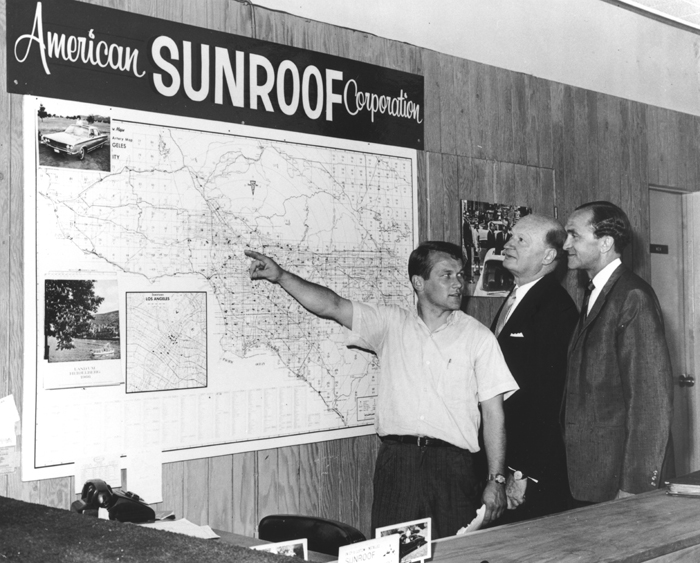
German immigrant Heinz Prechter, at the tender age of 21 and already established as a automotive trims specialist, came to southern California by the early 1960s to pursue a dream of sunroof manufacturing.
Though the idea was introduced back in the 1930s by Inalfa, a Dutch company, Prechter would be the first to mass-produce the luxurious car item by 1965, when his new company was started in a simple, two-car garage.
From its humble beginnings in the Los Angeles area, American Sunroof Company would move to Michigan in 1967, first settling in the city of Warren. The company would be given credit not only for introducing the sunroof, but additionally spurring a comeback of the convertible. High-profile sunroof installations done for celebrities ranging from Frank Sinatra to Steve McQueen, saw the company move briefly to Ecorse before settling in Southgate by the early 1970s.
American Sunroof would venture beyond sunroofs to producing some concept cars through the 1970s and into the 1980s. The company name was officially changed to ASC in 1982 to support its growing variation of operations. At its peak, the company had over 60 sites worldwide. Its local headquarters were off Interstate 75 and Northline Road. Prechter would further ambitions by transitioning the west end of Southgate into a major light-industrial park. He would earn the nickname “The Duke of Downriver” by this time, also adding a purchase of the News-Herald Newspapers to his growing portfolio.
Heinz Prechter tragically passed away in the summer of 2001, and the company was initially sold to Questor Management the following year. In a case of irony, what remained of the firm was sold to Dutch company Inalfa by 2007. The company arm ceased operations in their entirety on June 27, 2017, after having been known as American Specialty Cars.
Elf Atochem facility
Elf Atochem was but one of many names this manufacturer of lye and other chemicals has gone under since being formed in 1850 as Pennsalt Corporation. In 1860, the company laid claim as the first to export refined petroleum from the United States, with a shipment of 500 barrels to London, England.
In 1898, Theodore Armstrong, one of the principal operators of Pennsalt, purchased 100 acres of land along Pennsylvania Road on both the Wyandotte and future Riverview sides of the roadway. This area had natural salt deposits with a supply estimated to last at least 150 years. Caustic soda and chlorine were the first chemicals produced at this facility.
Pennsalt would change its name to Pennwalt in 1969 following a merger with Wallace & Tiernan. Elf Atochem would enter the Downriver vernacular by 1984 as a company specializing in manufacture of industrial and safety chemicals. The east plant bordering Riverview and Wyandotte was shut down in 1985 and, by 1989, was targeted by the United States Environmental Protection Agency in efforts to clean the contaminants in the land and water, specifically aiming for Halowax.
Nearby operations would continue without incident until July 14, 2001, when a railcar fire occurred on the property. The fire, called in to the Riverview Fire department by 4:10 AM, would ignite nearby gas and shot a fireball over 200 feet upwards. The chemical, known as methyl mercaptan, also set off a release of chlorine into the air. The fire was mostly contained by 9:30 AM; however, as a precaution, some 400 homes in Grosse Ile and many residences in north Trenton were evacuated.
At the time of the accident, Elf Atochem employed 212 workers on-site. Operations ceased not long after and, by the mid-2010s, the property was demolished, cleared, and initial operations of cleanup began. The area is currently secured away from the general public.
Eureka Iron Works
The roots of this pioneering industry date back to 1853, when Phillip Thurber came to the Wyandotte territory’s own Captain Eber Brock Ward with the exciting news regarding plentiful iron ore deposits during a recent trip to Michigan’s Upper Peninsula. The sample brought to the future Downriver area was of such high regard, that an idea to process the material was immediately put into place and incorporated that same year.
Fellow area pioneer Major John Biddle, would sell off his 2,200 acre estate, known as “The Wyandotte,” to the group headed by Ward. The cost of acquiring the waterfront land amounted to $44,000 ($1,567,183 in present-day funds). From this came the birth of the village of Wyandotte, first incorporated December 12, 1854, to house the initial workers. Captain William Bolton was assigned by Ward to transport the iron ore to an area already known for a vast array of natural resources, including forestry and limestone. Two furnaces were set up by 1855 to help establish the Wyandotte Rolling Mill Company.
Initial operations proved so successful and advancements were to the point that the first successful use of the Bessemer Process (which took out the imperfections of general iron to produce steel), today an integral operation for steel companies, occurred here in 1864 with the addition of steel ingot production. By 1865, the facility was firmly established as the producer of steel rails, setting the tone for all future production in the United States, which would spur the Industrial Revolution in the coming decade.
The success story was incredibly short-lived. Despite utilizing William Kelly’s converter for iron to steel, the Wyandotte plant was not designed as a general steel-making facility. Instead of gradually converting the facility to make production easier, Ward instead established new operations in Chicago. Raw materials were becoming scarce and harder to replace (such as timber), which resulted in charcoal having to be transported over for a higher cost. Iron was fast replaced by steel due to industrial demand, which came back to haunt them.
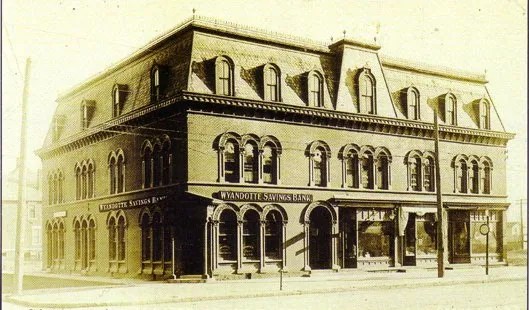
A series of boiler explosions beginning in June, 1888, hastened the demise of the Eureka Iron & Steel Company, which officially ceased operations in 1892. The oldest known commercial building in Wyandotte, which would house the area’s first bank (Wyandotte Savings Bank was established there by 1871) is the only remnant of this once-promising industrial firm.
Ford River Rouge Plant (Dearborn)
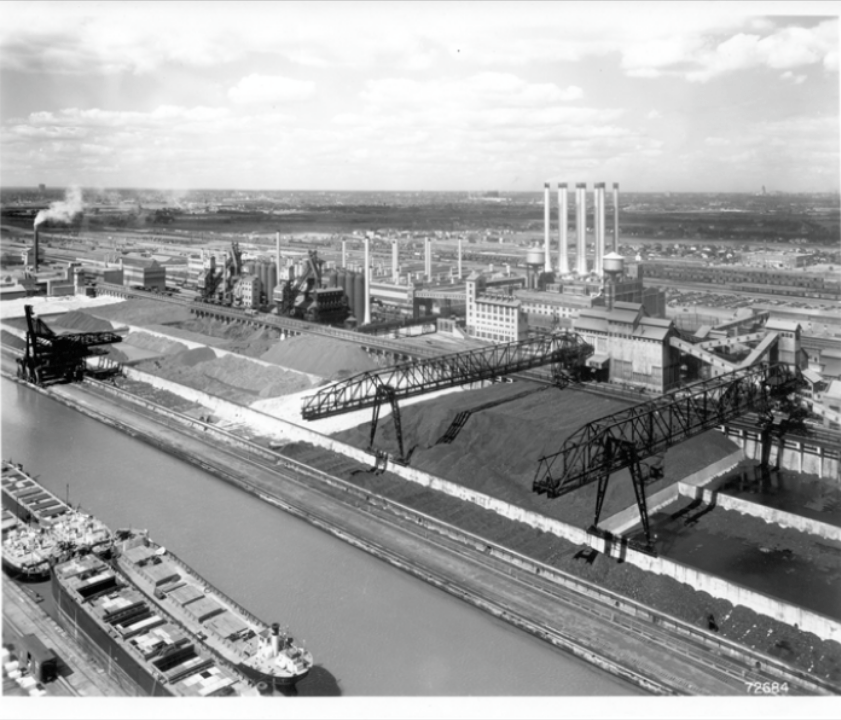
The Ford Rouge complex, bordering Dearborn and Detroit, broke ground in 1917, and upon its completion in 1928 was the largest integrated factory complex in the world. It is on the National Register of Historic Places, named in 1978, and also a State Historical site.
It is 1.5 miles wide by 1 mile long, comprising 93 buildings with a total of 16 million square feet of workable space. Some of the buildings on-site were designed by the renowned architect Albert Kahn. Even during the Great Depression, the Ford Rouge facility employed up to 100,000 people at that time.
The factory was one of the first examples of vertical integration, where everything is created, produced, assembled and transported on the same site. In the Rouge Plant’s case, this would mean everything from raw material to the finished automotive product. The idea was Henry Ford’s, as he sought to avoid possible damage to his vehicles through transporting them from the plant.
The complex, which once built the Ford Mustang from 1964 to 2004, and also the Mercury Capri and Cougar, now proudly builds the award-winning F-150 pickup. The site was an inspiration for renowned artist Diego Rivera, who studied the plant in its surroundings and used these to help produce his Detroit industry murals, which has been on display at the Detroit Institute of Arts since 1933. The complex was also the birthplace of the modern labor movement, capped off by the infamous Battle of the Overpass in May, 1936.
Although the debate may rage on fiercely for all time that the complex is not located within the boundaries of Downriver per se, it is given tremendous credit for contributing to the economic well-being of its establishing residents, and still does to this day.
Great Lakes Steel / National Steel
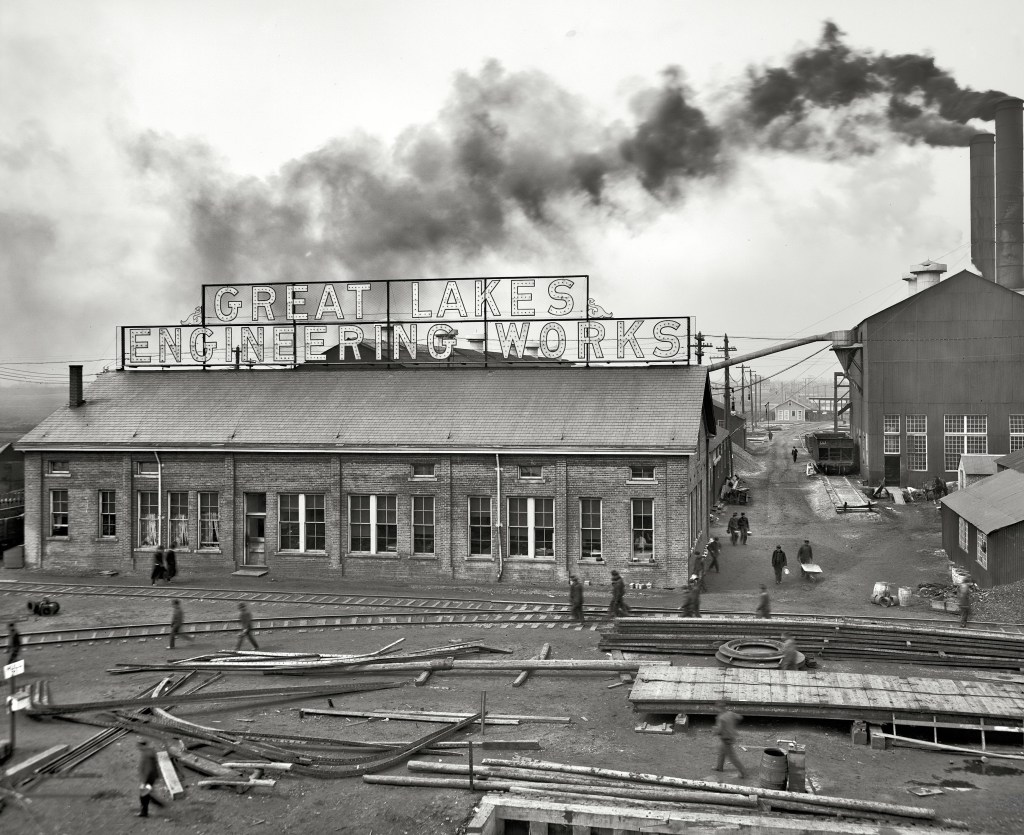
Although steelmaking and other businesses were in operation at neighboring Zug Island by 1902, investor George R. Fink sought to seize an opportunity to expand manufacturing in the Ecorse and River Rouge areas. Under Fink’s leadership, Michigan Steel would establish in 1922 and begin operations the following year in the area of Mill and Seventh streets. In 1929, the more-well known parent company, Great Lakes Steel, was formed. By 1931, the acquisition of the Hanna furnace operations at Zug Island was key in their initial expansion.
Upriver, National Steel began their operations by 1929 following an acquisition of Weirton Steel. It would directly service the automotive industry with the Ford Rouge plant located two miles away.
The original plant on Mill Street consisted of eight single stand mills with six to be supplemented with soft mills. A machine shop, electric shop, carpenter shop, grease house and general labor building completed the complex. During World War II, Michigan Steel participated in the war effort by producing large amounts of armor plate, among the largest quantities in the United States.
Due to shifting demand, operations on Mill Street began to whittle away in the 1970s and was largely left abandoned by the 1980s. National Steel began to feel a pinch around 1980 due to significantly lower demand. What followed was an up-and-down cycle of profitability for the next few years, but profitability would not last. National Steel declared bankruptcy in 2002, and what remained of the complex was sold off to U.S. Steel in 2003 for $850 million, while assuming $200 million in debts.
The Mill Street location would remain partially demolished and become an area eyesore for over a decade into the 2000s.
Marathon Petroleum Refinery
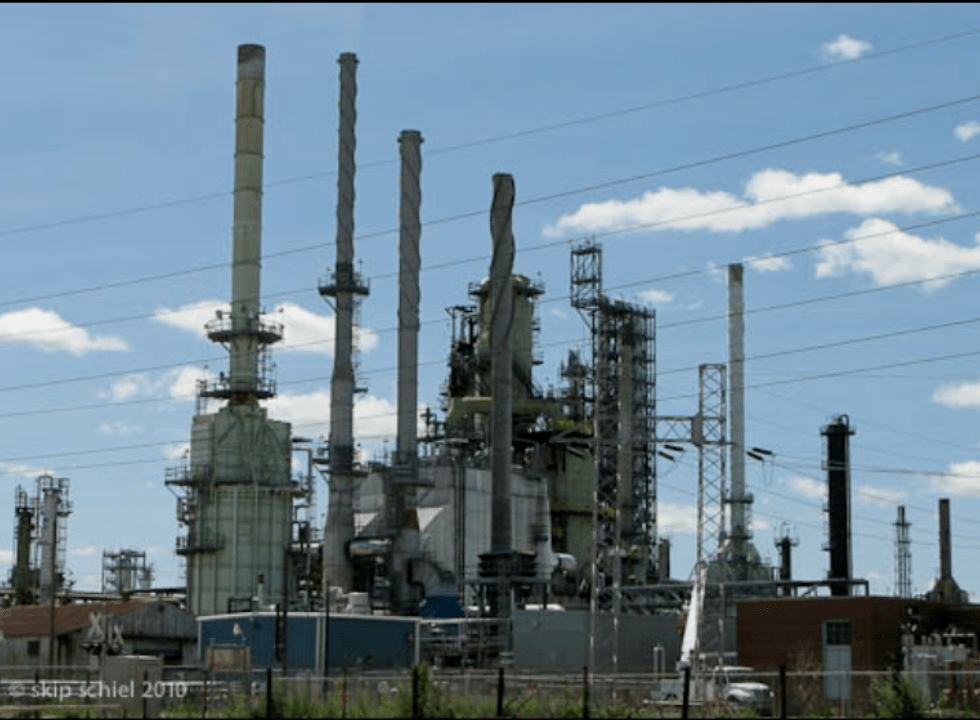
Currently located on 250 acres of land and employing 540 people, the Marathon refinery in Detroit was built in 1930 by the Aurora Oil Company, and purchased by Marathon, then known as Ohio Oil Company from the late financier Max Fisher in 1959. Upgrades were completed in 2012 to satisfy the requirements of the Detroit Heavy Oil Upgrade project. Current capacity is 139,000 barrels per day.
Of the three refineries once operational Downriver, Marathon is now the only facility in the state.
McLouth Steel (Gibraltar, Trenton)
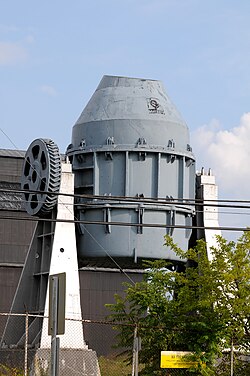
As happened so often while Downriver underwent its evolution, the southern area’s greatest industry had its beginnings in Detroit. Industrialist Donald B. McLouth selected land on Livernois Avenue and by the late 1930s, the first incarnation of McLouth Steel was formed as a small conversion mill.
It was simple in its operation, a small reversing hot rolling strip mill with slab-heating furnace. The sounds heard from the outside, which resembled coffee beans being ground, became familiar at this location for many years.
With modifications beginning in 1938, by the mid-1940s this plant had the capacity to produce 108,000 tons of hot-rolled steel, and 60,000 tons of cold-rolled steel annually.
In 1948, McLouth Steel started its $100 million expansion program by purchasing riverfront property in Trenton. Construction on the first major construction program was started soon afterward. The site was laid out and four, sixty ton electric arc furnaces were installed. Soaking pits, a blooming mill, a Steckel, an down-coiler and finishing equipment were installed. McLouth was soon established as a growing factor in the marketplace. The first ingots were poured in 1949. A few years later in 1954, the Trenton Plant was dedicated and McLouth Steel became able to produce iron as an integrated steel mill. Meanwhile, expansion would continue in neighboring Gibraltar, as in 1954 construction of a cold-rolling facility was announced, to be erected just south of the Trenton Channel Power Plant.
During the 1970s, McLouth Steel employed 5,000 people at what was then Michigan’s highest prevailing wage provider. In its heyday, the complex was also Detroit Edison’s second largest consumer of power (after the city of Detroit itself).
Cracks began to show toward the end of the 1970s, as overseas and non-union steelmakers began making inroads Downriver, promising less expensive production costs. In December 1981, the company defaulted on $166 million in loans and were forced to file Chapter 11 bankruptcy for the first time. A second bankruptcy request was filed in 1995.
After numerous ownership changes, in addition to a Downriver Community Conference grant that never went through, McLouth’s factories were renamed DSC Steel in 1997. Liquidation of the Trenton Plant was on the horizon by 1999, while the Gibraltar location had more success, operating as part of Detroit Cold Rolling from 1996-2006.
Today, the Trenton complex has been completely leveled as of 2025, following many years and stalled attempts at cleaning up the contaminated site. Gibraltar’s location is still in operation as a 2015 effort cleaned up that facility to the tune of $53 million, and has been officially considered a possible site for Downriver’s first AI data center as of 2026.
Michigan Alkali & Wyandotte Chemical
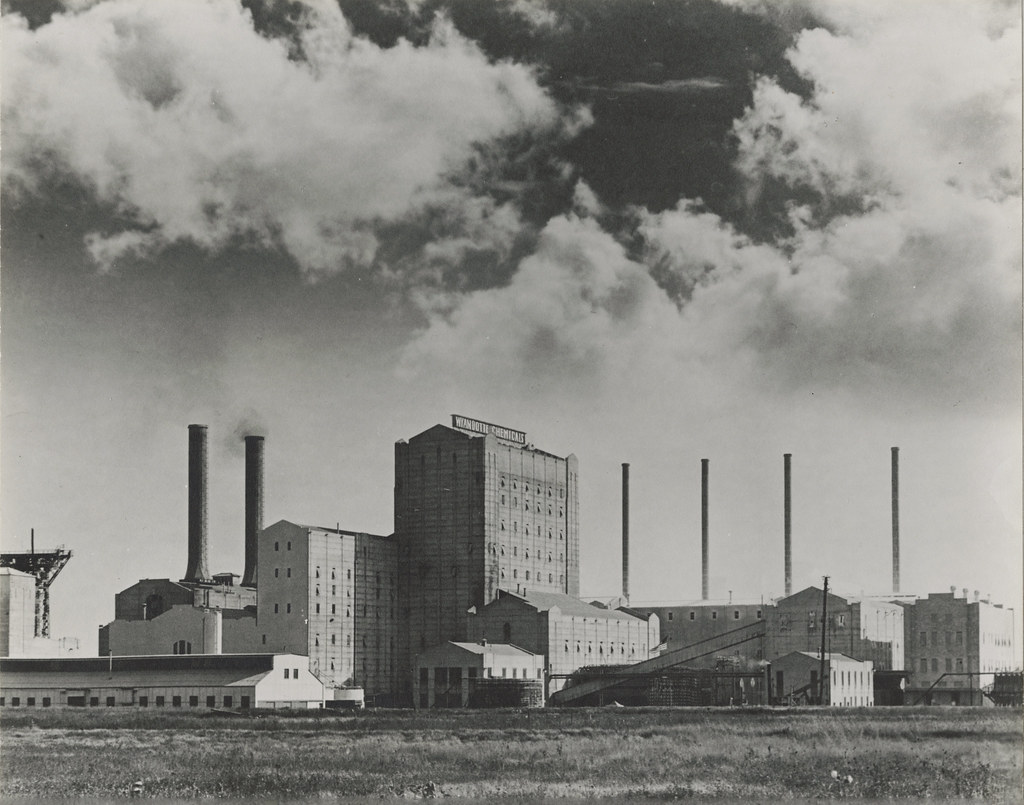
The precursor of today’s BASF North Works was formed in 1893 as the Michigan Alkali Company under the tutelage of Captain John Baptiste (J.B.) Ford. He located in the Wyandotte area from Creighton, Pennsylvania where he had begun the New York City Plate Glass Company, later named the Pittsburgh Plate Glass Company.
Mr. Ford was drawn to the area presumably by the large amounts of salt in the mines underneath Detroit and the surrounding vicinity. He would use this abundance of salt in the production of caustic soda ash, which would aid in the mass production of glass products.
Later renamed Wyandotte Chemicals Company, the campus would grow to dominate the Wyandotte riverfront for generations and its production of soaps, baking soda, cleansers and lyes. Wyandotte Chemical was divested into the BASF group of holdings in 1969, and has also been known as Diversey Wyandotte during the 1980s.
The environmental movement of the 1970s pushed BASF to rethink its riverfront industrial capabilities in an effort to promote cleaner soil and air. The South Works facility was shut down in stages beginning in 1979, and now has been restored as Wyandotte Shores Golf Course. The majority of the heavy pollutants from the North Works facility were eliminated, but production still continues of various chemicals at that location today.
Shipbuilding
Wyandotte began its shipbuilding ambitions in 1870, and through 1923 built over 200 ships. Its main purpose was to construct the hulls, then ship them upriver to be completed.
The Detroit Dry Dock Company was also in operations in this area, having bought a Wyandotte shipyard of its own at the turn of the century and lasting until 1924.
The Great Lakes Engineering Works (GLEW) was formed in 1902 as a way to purchase Riverside Ironworks. Its predecessor, Samuel F. Hodge & Company, was noted for the production of steam engines. Various acquisitions, led by the charismatic president Antonio C. Pessano from 1903 (Ecorse site) to 1912, would establish GLEW as a prominent riverfront operation capable of maintaining several shipyards.
The first notable hull to launch from the new River Rouge facility (formerly referred to as the Ecorse facility) was the Fontana. The Northwestern Mutual Insurance Company employed GLEW to construct the first “super freighter,” putting them on the map. In its initial surge, approximately 1,300 were employed. Previous to that, in 1908 the SS Wyandotte was launched from the Ecorse site and was the prototype for the modern-day self-unloader.
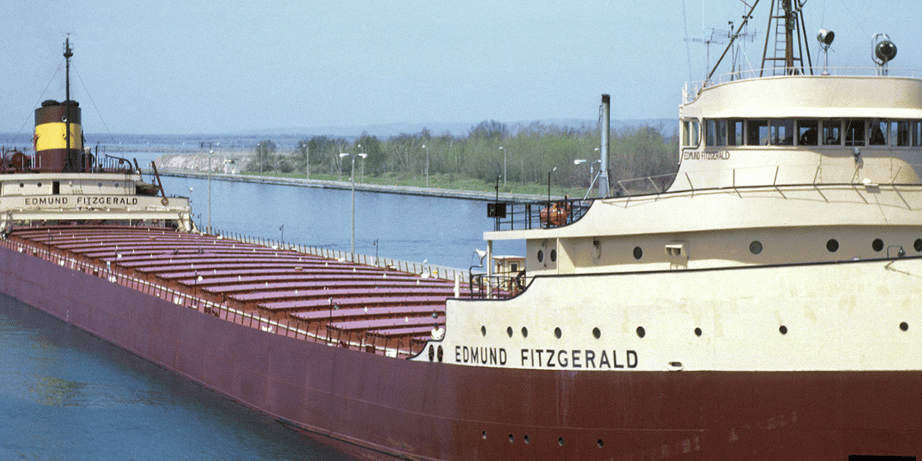
Wartime aided GLEW to a great extent, as the U.S. Navy Appropriations bill for 1941 awarded Great Lakes shipyards government contracts worth almost ninety million dollars. The GLEW was responsible for twenty-one new ore carriers. Within a year, contracts came at a blistering pace to where the facilities were already over capacity. Once World War II ceased in 1945, demand for shipbuilding product declined due to an overabundance of ships already commissioned. This resulted in the start of GLEW’s decline, but not before the production and launch of perhaps its most famous ship of all: the Edmund Fitzgerald, which was launched in June of 1958, and remained in service until its fate was met on Lake Superior in November, 1975.
With domestic ship orders falling through the 1950s, foreign shipbuilders began making inroads and began to claim more orders. With American shipping companies now dealing almost exclusively with overseas firms, GLEW met its own fate with its sale on April 30, 1961 to U.S. Steel Corporation.
Sibley Quarry
Sibley Quarry initiated operations in 1823 and was founded by Solomon Sibley, who was a Detroit-area businessman and the first U.S. Attorney for the former Michigan territory prior to statehood.
The quarry initially produced limestone and dolomite for various construction projects, including Fort Detroit. It was later used by Austin Church (of Arm & Hammer fame) for producing baking soda.
The quarry recorded one of the most damaging accidents in its history on January 30, 1900. It was attributed at the time to dynamite being stored in a small shanty (estimated to be 2,450 lbs). The quarry operator (Thomas Fitzpatrick) claimed one stick of dynamite was dropped, which caused a chain reaction and the entire shanty to be destroyed. This claim was never confirmed or officially denied. The explosion could be felt as far north as Grosse Pointe, north of Detroit. Only one fatality, Nelson Burbo, was recorded on site.
The quarry would anchor Sibley Village in the early part of the 20th century before being annexed by the Village of Riverview in 1929. By 1951, the Detroit Edison Company purchased the land for storage of fly ash used in the construction of power facilities. At its peak, the mining operation reached 300 feet below ground surface levels and was easily visible from Fort Street. Berms and foilage were added to the Fort Street side of the complex sometime in the 1980s.
As of 2026, it has been estimated that Sibley Quarry – still active and operated by DTE Energy, has roughly twenty years of operative life remaining; indicating that the deposits will reach ground level between 2041-2045. At that time, the area is expected to be capped off with vegetation planted.
Zug Island steelmaking & industry
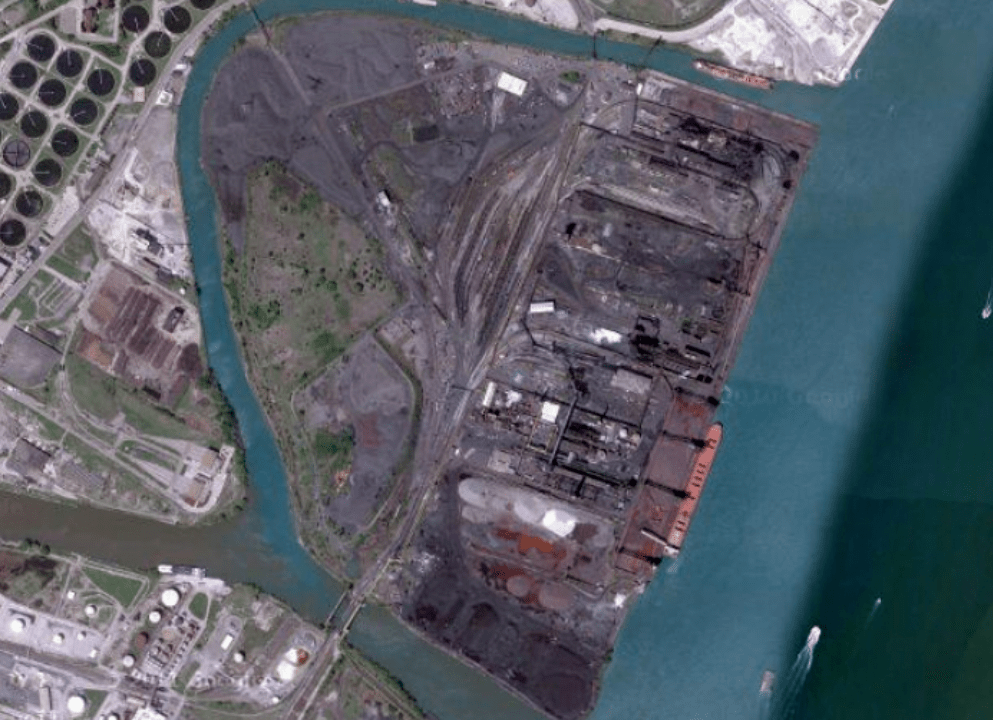
Zug Island was originally part of the mainland of the Delray section of Southwest Detroit, although it has not held that status since 1906.
The 334 acre parcel was purchased by furniture mogul Samuel Zug in 1859 in the hopes of putting a mansion in place. The ground proved too swampy, so construction of structures never took place. By 1888, Zug directed the River Rouge Improvement Company to dig a canal, forming the present-day perimeter of the island.
Zug sold off his interests to the land in 1891 to George Brady and Charles Noble, whose initial intent was to use the land as an industrial waste dump. The first of the blast furnaces prevalent today were constructed on site in 1902, and various steelmaking Industries have grown and thrived in the vicinity since that time.
Zug Island has been considered part of the city of River Rouge since that city’s formation in 1922.
Know of any other larger industries we may have missed? Contact us.
 downriverhistory.blog