Please read disclaimer first
Adding this page onto the website was done only after a great deal of thought. The devastating incident that took place on August 4, 1989, may well be Downriver’s most tragic story in the last fifty years, along with Northwest Flight 255. It touched and affected so many people in so many ways then, and even 37 years later (in 2026), we have not brought it up on our Facebook page for discussion.
I do aim for this to be a nostalgic site, one where a person can log on and spend hours looking through our stories and photos, and get a grin & chuckle from the way things used to be. Yet it must be noted that history is not always kind.
Virtually nothing which exists – be it person, place, thing or event – has lived a pristine lifetime. There are “flaws in the ointment,” so it is said, no matter where you turn to, and this site tries its best to avoid the negative feelings and aroused anger.
Sometimes, however, events occur which simply cannot be ignored because – negative or not – the events have interwoven into history.
When so many people remember the date, the event, where they were when it occurred… to spur the obvious facts would be a disservice to those seeking a complete history of our area. Therefore, the event is being included in this website.
– KEVIN HARRISON
The tragedy unfolds in Wyandotte
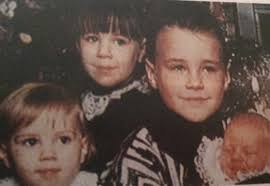
Shortly after 9:00 PM on the night of August 3, 1989, Lincoln Park resident Lawrence DeLisle, driving his early-1980s model Ford LTD with his wife, Suzanne, and their four children – Bryan, Kathryn, Melissa and Emily, sped through the barrier ending Eureka Road east of Van Alstyne in Wyandotte, directly into the Detroit River. Sinking under 30 feet of water, Mr. & Mrs. DeLisle were able to exit the windows of the vehicle and swim to safety.
Wyandotte Rescue was on scene in minutes and were able to recover the car, but too late to prevent the deaths of the four children. When initially questioned, DeLisle, 28, claimed a leg cramp caused him to floor the accelerator and crash thru the barrier into the river. Investigators, however, did not accept his explanation as valid. It was later reported that DeLisle had a motive, for reasons unclear.
The story made national and world headlines. DeLisle was accused of four counts of first degree murder, and one count of attempted murder of his wife.
Background & prior events
A Downriver resident for most of his life, Lawrence DeLisle had dropped out of high school at age 19 and married early as well. While the growing family was living in Taylor, he was the service manager of a tire store in Lincoln Park. The family would move to Lincoln Park shortly before the tragedy.
The car in DeLisle’s possession had belonged to his father, Richard, and it had been involved in another personal tragedy in 1988. Richard drove the car out to Elizabeth Park in Trenton, and then committed suicide with a pistol. The car was given to Lawrence as a gift from his stepmother after the incident.
During & after the incident
After running some errands in downtown Wyandotte on the night in question, which ended with a drugstore visit, Suzanne DeLisle and the four children watched in horror as DeLisle drove at speeds in excess of 45-55 MPH down the two-block stretch of Eureka east of Biddle, crashing through the barrier and into the river. A passing powerboat was able to aid the parents to safety; however, the car with the children sank 25 feet to the bottom of the river. DeLisle’s initial statement also included reports of a stuck accelerator, with Suzanne indicating she attempted to steer the car in a different direction, but failed.
The Wayne County Sheriff Department arrived on scene and pulled the children from the river by 11:00 PM. They exhibited no vital life signs. Despite this, resuscitation efforts were immediate at Wyandotte General Hospital. Two of the children were airlifted to Henry Ford Hospital, Detroit, before being officially pronounced dead.
When initially questioned by local authorities, DeLisle reported he had multiple cramps in his leg during his initial ride down the riverfront, but the symptoms subsided as the evening went on. However, on approaching Eureka Road, they returned and caused him to jam the accelerator. His other foot was reportedly stuck between the pedals, unable to unjam.
The authorities became suspicious after DeLisle told them he and his wife were only able to exit the car once it touched the bottom of the river. Witnesses on scene reported they saw husband & wife surface before the car actually sank. Other information would be provided regarding sighting of the vehicle driving the neighborhood the previous night at slow rates of speed. The investigators came to the initial conclusion that DeLisle was in fact plotting a murder-suicide.
The trip to Lansing and trial
About a week after the tragedy (with no explanation available regarding the reason for the length of delay), DeLisle and his wife were escorted to Lansing’s Michigan State Police base, where he was given a polygraph test and spoke with various officers through the day. Officially placed under arrest just before 7:00 PM, he would be transported back to Wyandotte to meet with Sgt. Daniel Galeski who believed, in the ensuing interviews with DeLisle, that he may have wrung out a confession.
Through videotape, DeLisle mentioned that home life was getting the better of him, with stress from work life, bills, and the children all contributing factors (“I just wanted it to be over. The constant repetition. Same thing day after day.”) In spite of his initial comfort with the car he had been given, he now expressed hatred of it, since it had been used by his father when committing suicide the previous year, “without having a chance to say goodbye.” When pressed about not using the brakes to stop the car, DeLisle stated, “(I) just couldn’t… I didn’t want to. I don’t know why,” not even recalling his children were in the car at that particular moment.
This was also not the first time DeLisle attempted to end his life recently. He had tried holding a lighted candle near a leaking gas line near his dryer, but nothing happened. “I just wanted to be free,” he said, “blow up everything in my past.” DeLisle concluded the interview by mentioning he did not even want to go to trial.
The following day (August 11) came the official charges of four murders, with an attempt at a fifth toward his wife. Immediately, DeLisle’s attorney attempted to dismiss the videotape interviews as miscellaneous ramblings. DeLisle himself said he was “brainwashed” doing the entire interview, as his thoughts were now only with his deceased children, while having to face the press daily. He stated the police were pressuring him into admitting a “lone wolf” situation by getting him to admit there was “a demon inside him,” that he may have been suffering from split personality, or was coerced into telling the truth in exchange for a more lenient sentence.
Was all this admissible in court? DeLisle’s attorney argued it was not, and on December 21, Wayne County Judge Robert Colombo Jr. agreed that the evidence was not admissible. The media requested viewing of the tapes in question, which was granted. Still, the eventual decision was the same as Judge Colombo’s.
The trial would take place in June, 1990, but was met with roadblocks. It was argued that a neutral site for the trial be used, as there was doubt DeLisle could ever obtain a fair trial Downriver. There was also concern regarding makeup of the 12-member jury to be seated. All were aware of the August 3 event, but no one claimed they had inside details, and that judgment could be placed without prejudice.
The trial would be the first in Michigan history which would allow videographers and cameras inside the courtroom, as they would be in a booth on the far side of the room. During the trial, which lasted five days, Suzanne DeLisle would testify that her husband had prior problems with leg cramps, and that she lifted his leg off the accelerator, but the car still raced. Also deposed was the mechanic who worked on the station wagon before, and he stated it had a history of racing without control.
The prosecution pointed to a dent on the left front wheel which indicated it struck a curb before capsizing. This was consistent, they claimed, with someone trying to steer the car in a specific direction; in this case it would have been between the barricades. Other witnesses confirmed the vehicle was in the neighborhood the night before, and even the boat master who rescued the parents mentioned DeLisle wasn’t asking about the children’s welfare.
After an 9.5 hour deliberation following five days of arguments, the jury unanimously found Lawrence DeLisle guilty of all charges. One juror noted afterward that Suzanne DeLisle’s testimony was only “to save her husband,” and was actually considered contradictory to the defense’s claims.
He would receive five consecutive life terms without possibility of parole. In his final court statement, DeLisle said, “I panicked. I froze. That is my guilt, not murder. I was paralyzed with shock and unable to react. That is my crime.” Judge Colombo gave the sentence with a hint of doubt: “I don’t know if he’s guilty of (first degree murder)… I just don’t know.”
DeLisle immediately appealed the verdict, and once again demanded a new trial at a neutral site, with his defense team admitting the release of the videotape interviews with Sgt. Galeski tainted the jury pool. It would go to the Michigan Court of Appeals, which would uphold the final decision in a 7-6 vote.
Recent updates on the case
By 2024, Suzanne DeLisle had long since divorced Lawrence and remarried. Taking a totally different tone than in 1990, Suzanne believed her husband was solely responsible for the crime, saying she was “gaslit” by his feigns of innocence during the trial. Judge Colombo was also more definite in his thoughts, saying he was now convinced DeLisle was a “mass murderer.”
DeLisle himself appeared on WWJ radio about that time, claiming he was a “good, kind and innocent man” who blamed the media for how the story turned out. He was still of the belief that cramps and the sticky accelerator were responsible for what happened.
To this day, he continues to serve his five consecutive life terms at the Lakeland Correctional Facility in Coldwater.
 downriverhistory.blog