The giant Uniroyal Tire, Allen Park
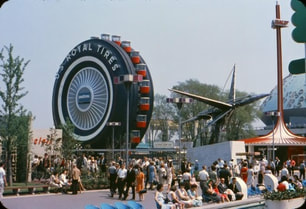
Virtually nothing symbolizes Detroit’s background as the Motor Capital of the world better than this gift from the World’s Fair of 1964-65, which was held for two six-month periods in Flushing Meadows, New York, near the former Shea Stadium (the fair’s theme: “Peace Thru Understanding”).
As can be seen, the eight-story, approximate 100 ton structure – properly titled Uniroyal Giant Tire – did start its life at the event as a Ferris wheel with “US Royal Tires” originally emblazoned on it.
The attraction carried nearly two million people during its stay in New York, including former First Lady Jacqueline Kennedy and her daughter Caroline. The structure was designed by the same firm who previously designed the Empire State Building.
Preparing for its move from New York to Allen Park (where Uniroyal once had a corporate office; that space is now part of Baker College), the giant Ferris wheel was sold to an amusement park in New Jersey (where it served until 1972), and the 116 exterior tire sections were shipped to Allen Park in 1966, where it took four months to reassemble them to a new steel structure.
The website Roadside America suggested a one-time rumor that the tire once broke off its moorings and rolled across I-94. That of course has not occurred.
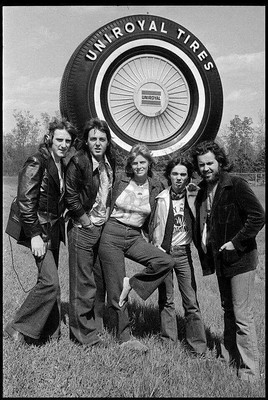
It has undergone three modifications since then; one of which added new wheel covers and tire shoulder sections in 1994. In 1998, a giant “nail” was stuck on its top. The most recent update was completed in 2003 at a cost of $1 million, funded by Michelin Group (which bought the Uniroyal name in 1990).
(Contributor: Steven J. Frey)
Allen Park Veterans Hospital
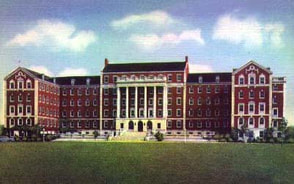
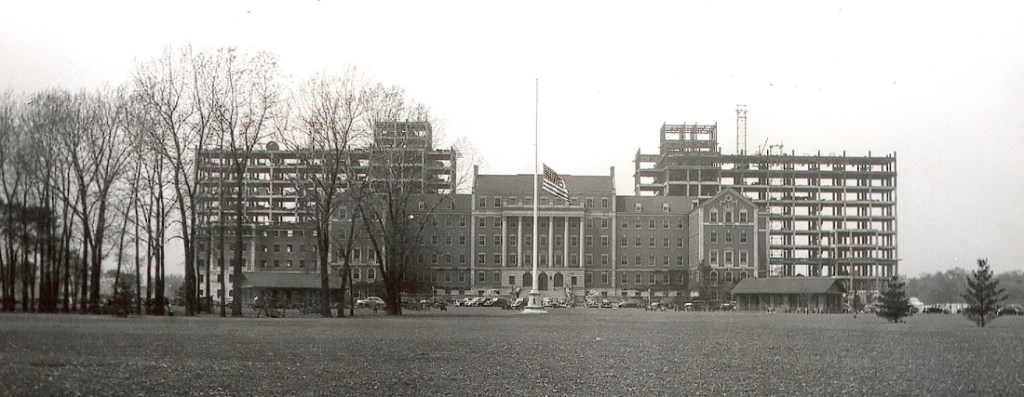
This historic structure was built in 1939 on land deeded by Henry and Clara Ford. Comprising 38 acres at the corner of Southfield Road and Outer Drive, the original building shown here was later complimented by additions made during World War II, and again during the 1960s.
It was entered into the National Register of Historic Places in 1981, and as recently as 1988, was the subject of a massive restoration and renovation project headed by Congressman John Dingell. However, a replacement facility was constructed within the Detroit Medical Center, opening in 1996 and mothballing the Allen Park complex, in spite of Mr. Dingell imploring that the area needed “a dual campus.” After much consideration, the structure was torn down in stages during 2004.
Security Bank Tower, Southgate
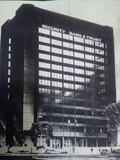
The Southgate Tower, known to many as the Security Bank Building, is located in Southgate where Fort Street, Pennsylvania and Trenton Roads converge, and has been a landmark in this spot since 1973. It sits on what once was the grounds of the old Wonderland Amusement Park.
The tallest building between Detroit and Toledo, it was locally well-known for its annual Christmas tree formed by green and gold lights in its windows. In 2016, it was announced the tower was completely vacated following the departure of PNC Bank, with vandalism taking place. By 2021, Southgate Mayor Joseph Kuspa announced the site was currently under review for repurposing as a possible apartment complex.
Finally in 2023, plans were approved for the tower to house high-level apartments, a nature area, and bridge over Trenton Road to connect with Kiwanis Park. The overall restoration project was due to be completed late in 2026.
White Star Refinery, Woodhaven
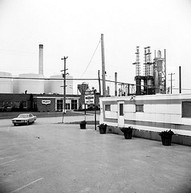
White Star Refining began along Allen and West Roads in the early 1920s, and became one of three refineries (and one of four tank farms) to have operated Downriver; the other facilities being Marathon’s complex in Detroit/Melvindale, and Petroleum Specialties Incorporated (PSI) near Flat Rock.
Major operations began phasing out in this location in the early 1980s after many name changes to the facility (Socony-Vacuum, then Socony-Mobil). A decade later, the area best known as the Mobil Refinery would be cleared and readying for the multitude of shops now located along that stretch.
WJR Radio Transmitter, Riverview
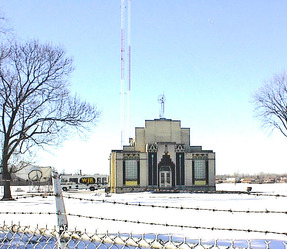
The original WCX-AM when broadcasting debuted in 1922, WJR would move its offices to the iconic Fisher Building in Detroit around 1928. Transmitting power increased from its initial 10,000 watts up to an eventual level of 50,000 watts.
To help provide for the increased modulation, a new facility was sought out and found at the corner of Sibley and Grange in Riverview. Designed by Cyril Edward Schley and constructed in 1934 using Zig-Zag Art Deco, it is somehow not yet listed in the Michigan Register of Historic Places, yet it is probably without a doubt Downriver’s best example of Art Deco on any of its commercial buildings today.
Telegraph / I-94 blue bridge
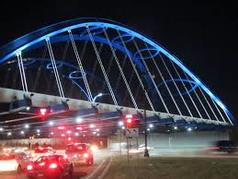
Public sentiment on this structure since its opening in 2004 has been vocally mixed. Some have called it a massive improvement over the double-viaduct setup of the 1960s which preceded it (the interchange had a dangerous left-hand merge/left-hand exit setup), while some have referred to it as “The Big Blue Blunder,” saying state money should have been spent on freeway or road resurfacing instead.
Geared to give travelers from Detroit Metro Airport an impressive sight to see in time for the 2005 Super Bowl in downtown Detroit, this particular bridge/interchange setup is the only one of its type in the state of Michigan, and has been proven to cause fewer accidents in the time it has been in service.
Downriver’s water towers
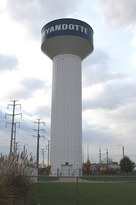
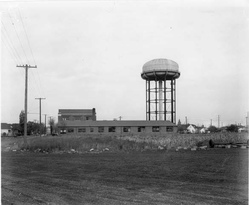
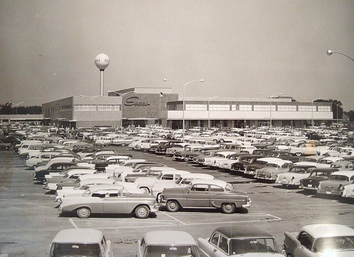
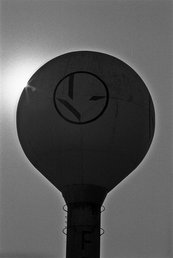
Water towers appear to be revered among many Downriver residents thanks to various Facebook posts throughout the years. Of the many which our area had, two stand out in particular: the ones which stood guard over Sears Lincoln Park Shopping Center, and Southgate Shopping Center.
The Sears water tower, anchoring the plaza in Lincoln Park, stood until 2025, and underwent only one modification in nearly sixty years of existence. It was originally an all-silver tower with SEARS in big, black, capital letters. Around the time of the Sears store’s exterior modifications (late 1990s), the tower received its more recent look. This water tower would bear witness to this particular Sears store becoming the most successful in the world during a stretch in the 1960s.
The Southgate water tower had its own interesting history. Situated at the foot of Federal Department store, its role was to signify what would be Downriver’s largest shopping center from 1958 to 1970. The large “S” on the crown and “Federal” running down the tower stem were fixtures into the early 1970s.
For a brief time after, the “S” was replaced by a decorative “down” arrow (or so it looked) which pointed toward the Federal banner. Finally by 1978, Service Merchandise had replaced Federal in the center, and the tower was repainted with the company’s logo.
The tower was drained of water in the 1980s when a central fire suppression system was installed at the center, and a rapid deterioration of the structure began, lasting into the mid-1990s. A News-Herald article then told the story of a Southgate Schools student – Paulina Solis – who wrote a letter to the city suggesting the tower be rehabilitated. Surprisingly – since the tower was empty and of no practical use – it would be. Repainted with a “Welcome to Southgate” message with Service Merchandise’s new logo underneath, it garnered local news and kudos for the student: an excellent example of a single person’s preservation movement. It would last until falling the wreckers’ ball in 2004.
Other city-owned water towers no longer there include those in Lincoln Park (dismantled early 1980s), Trenton (torn down 1965), and Wyandotte’s original tower (replaced in 1990-91). The other water tower currently active is located in Rockwood, easily spotted from I-75.
The Wonder Well, Grosse Ile
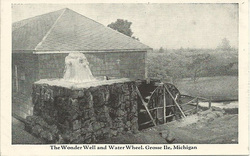
Located on the southern part of Grosse Ile off Southpointe Drive, the Wonder Well produced a natural flow of two million gallons of water daily at its peak.
The well was drilled in 1903 in an attempt to locate oil, but drillers mistakingly drilled into this spring rich with mineral water. The water was taken from here and bottled for medicinal purposes throughout Michigan and Ohio up until 1957.
The Wonder Well eventually ran dry in 1994. The adjoining property, which housed a cinder-block store selling fireworks in-season (and well known for the sulfur smell in the air), was vacated in the early 2000s, and demolition was complete by 2013.
The Grosse Ile Lighthouse
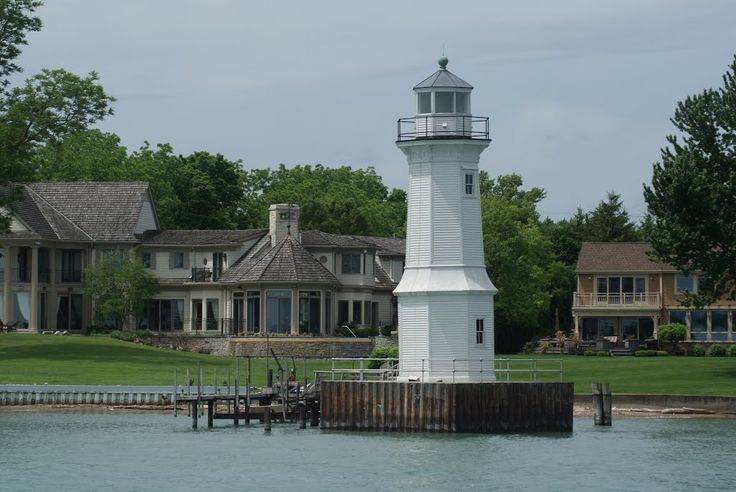
With the dawn of the Industrial Revolution by the 1870s, the Detroit River became a huge shipping point for trade, not just for neighboring Canada but other states bordering Michigan in the high Great Lakes area. Initially, shipping could only occur during the day, which led to the Cleveland Vessel Owners Association petitioning to have range lights installed through the Downriver section of the Detroit River in order to facilitate night-time shipping for steamboat traffic. This request was granted and by 1891, the first front and rear range light appeared on Hennepin Point.
That location was chosen to guide these ships past the sandbar off the southwest point of Fighting Island. These lights were designed to help up-bound traffic. In 1894, the United States Congress set funding aside to place another pair of lights to service traffic heading toward Lake Erie. This is where the Grosse Ile North Channel Front & Rear Range lights were commissioned, with their first date of service being July 16th. The location was chosen to identify the Fighting Island Channel north of Mamajuda Island.
The North Channel light erected by 1894 is not the structure seen today on the east end of the island. It more resembled a water tower on stilts and was constructed on wooden pilings along a 170 foot pier from the shore. The lighthouse underwent a total rebuild, and the present structure surfaced by 1906. The rear range light, which was actually taller, was located north of Horsemill Road near present-day Parke Lane.
The lifespan of the rear range light was only eighteen years. With the opening of the Livingstone Channel by 1912, and other waterways being dredged and straightened, the north channel itself would cease to exist, and that light was decommissioned and razed. Only in a few rare, early photographs can this lighthouse be viewed.
The North Channel Front Range Light (now simply known as Grosse Ile Lighthouse) was in active duty until 1963 when the lights were shut off and the lens removed. In 1965, with the assistance of the Grosse Ile Historical Society, the lighthouse was purchased for the sum of $350 by the Township from the Department of the Interior. It is funded strictly by private donation, with the majority coming from the Lighthouse Endowment Fund. Until recently, annual tours were given of this structure in September of each year.
 downriverhistory.blog